Why Modular PeopleSoft Architectures Are Winning in 2026 + How To Guard Your Org From Taking the SaaS Cloud Pill
A Comprehensive Analysis of the Modernization of PeopleSoft versus Replacing it for SaaS Applications

Happy New Year! I wanted to start out the new year with this topic as it remains on the minds of so many PeopleSoft Pros. The pressure to abandon the core has never been higher, but the logic for staying has never been clearer. We’ve reached a point where “migration” is often used as a euphemism for “unnecessary risk.”
I want to be plain about this: The era of the monolithic, stagnant ERP is over, but that doesn’t mean the systems themselves have to be. We are moving from a world of forced replacements to a world of intelligent evolution.
The narrative surrounding enterprise software has become remarkably predictable. We are told that the age of the monolith is over, that on-premises systems are effectively “technical debt” in waiting, and that the only path to the future is a total “rip and replace” migration to the cloud.
I want to sit with that for a moment.
The suggestion is that three decades of institutional logic—the very workflows that define how a global company actually functions—should be decommissioned in favor of a clean slate. This is often framed as a technical necessity. It isn’t. It is a strategic choice, and increasingly, it is the wrong one.
What we are seeing now is a profound re-evaluation of the ERP landscape. The “rip and replace” model is hitting a wall of financial and operational reality. In its place, a different model is emerging: the modular PeopleSoft architecture.
This isn’t a tooling change. It’s an operating model change.
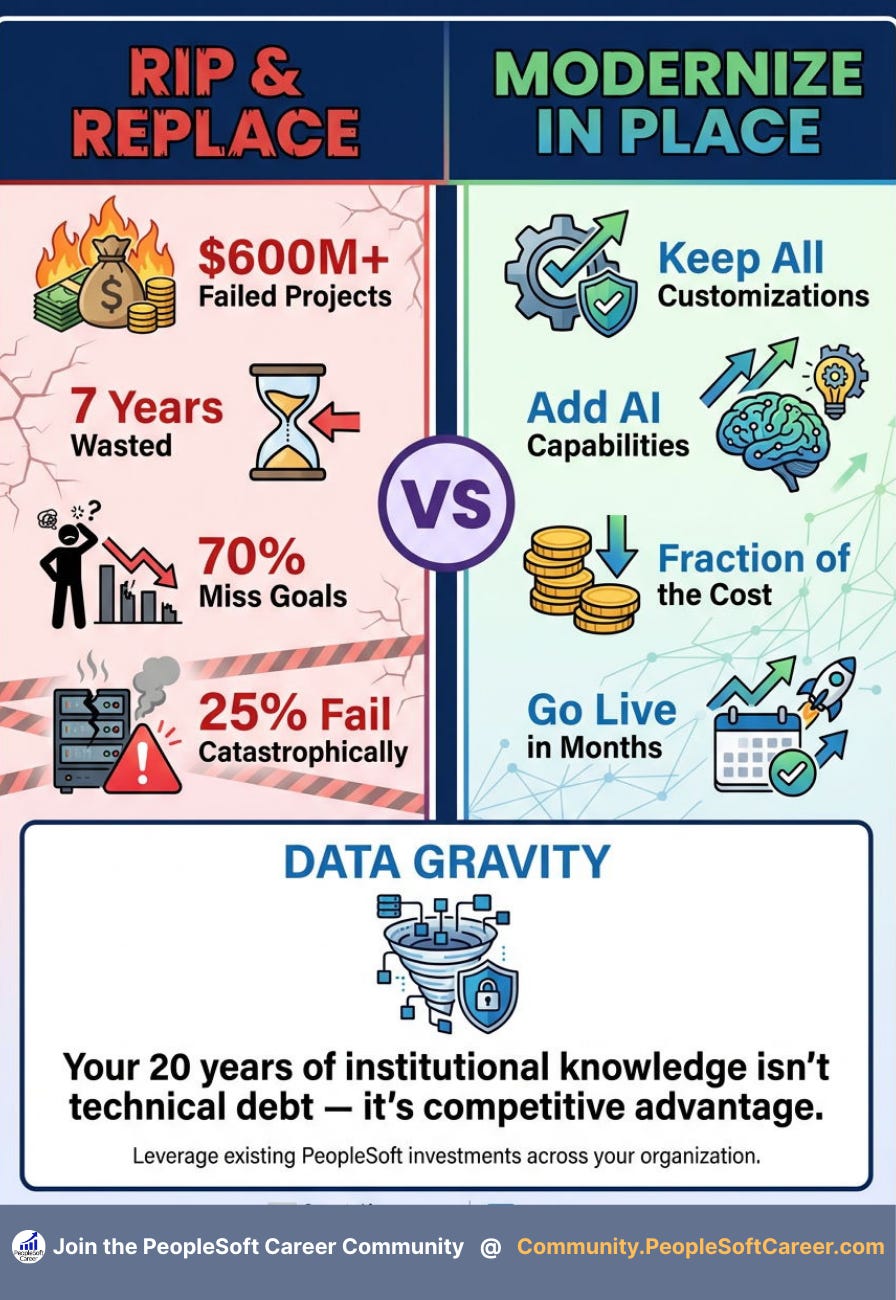
To understand why this matters, we have to look at the cost of the “clean slate” mirage. Consider Lidl, the German grocery giant. They spent seven years and $600 million trying to replace their legacy system with a standard SAP implementation. The project failed because the software’s rigid retail-price logic couldn’t handle Lidl’s unique purchase-price inventory model. They eventually scrapped the entire thing and went back to their legacy system. Or look at Revlon, where a botched ERP migration resulted in $64 million in lost sales because they simply couldn’t ship products to their customers.
These aren’t technical glitches. They are the systemic results of ignoring “data gravity”—the immense institutional knowledge baked into your current system over decades.
What This Means for Your Team
This shift isn’t just about the software; it’s about how your people work. Each role in the organization sees a different version of this evolution.
For Developers: From Maintenance to Orchestration Historically, PeopleSoft development meant managing deep PeopleCode and SQR customizations that often made the system brittle. In a modular architecture, the focus shifts to the Application Services Framework (ASF). Instead of writing monolithic code, you are building RESTful APIs that allow PeopleSoft to serve as a modern hub. You are no longer just “fixing the ERP”; you are orchestrating a multi-cloud ecosystem where PeopleSoft interacts seamlessly with specialized third-party services.
For System Administrators: Infrastructure as Code The days of manual environment setup and “server hugging” are gone. With PeopleSoft Cloud Manager (PCM) on Oracle Cloud Infrastructure (OCI), your role becomes one of automation. You can provision entire environments on-demand using templates and automate the patching of PeopleTools and the database with a single click. Tools like Exadata Sparse Clones allow you to scale resources instantly while significantly reducing storage costs. You move from being a hardware gatekeeper to a cloud architect.
For Functional Analysts: Sovereignty Over the Roadmap The “update treadmill” of SaaS can be a source of constant fatigue for analysts. A modular PeopleSoft architecture changes this by allowing you to adopt only the features that deliver actual business value. You use tools like the Page Field Configurator and Drop Zones to “de-customize” the system without losing specialized functionality. Your work shifts from managing the disruption of forced updates to strategically selecting innovations that improve user experience via the Fluid UI.
For Leaders: Financial and Operational Predictability For executives, the primary gain is risk mitigation. More than 70% of ERP initiatives fail to meet their original goals, and 25% fail catastrophically. Modernization avoids this “all-or-nothing” gamble. Financially, it replaces the massive CapEx of a full replacement with a predictable, incremental OpEx model. You gain the agility and AI-driven insights of the cloud without sacrificing the unique business logic that gives your company its competitive edge.
Here is the overview of what we are covering in this analysis. This isn’t just about software versions; it’s about the structural shift in how enterprise logic is maintained and modernized in a PeopleSoft installation.
The End of the “Big Bang” Upgrade. How the introduction of Selective Adoption moved PeopleSoft from a cycle of risky, multi-million dollar upgrades to a model of continuous, sovereign delivery.
The Financial Reality of Modernization. A ten-year Total Cost of Ownership (TCO) breakdown showing why replacing a mature ERP is often the most expensive choice an organization can make.
The Risk of the Clean Slate. Lessons from the $600 million failures at Lidl and Revlon regarding the “data gravity” and institutional knowledge inherent in mature workflows.
The Architect’s Shift. How moving PeopleSoft to run on OCI and the Application Services Framework changes the role of developers and administrators from maintenance to ecosystem orchestration.
The Composable Core. A framework for modernizing the user experience and infrastructure while preserving the specialized logic of the core system.
Operational Arbitrage. A real-world study of a global manufacturer that achieved significant performance gains and mobile self-service in five months, avoiding the “migration tax” of a full platform swap.
The Shift Beneath the Surface
For years, the “big bang” upgrade was the tax you paid for running a stable system. Every few years, you would stop everything, spend millions, and pray that the regression testing caught the thousands of ways a major version change could break your business.
That era has ended.
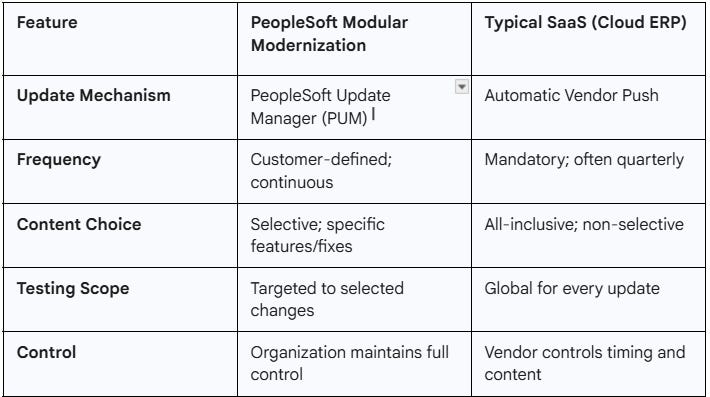
The introduction of Selective Adoption and the PeopleSoft Update Manager (PUM) changed the physics of the system. We moved from version-based software to continuous delivery. In a modular architecture, there are no more major upgrades. There is only the continuous application of innovation.
This is a fundamental shift in sovereignty. In a typical SaaS model, the vendor dictates the schedule. They push an update on a Friday, and your business processes must adapt by Monday, regardless of whether you are in the middle of a year-end close or a massive hiring surge.
PeopleSoft’s Selective Adoption returns that control to the organization. You decide what to apply, and more importantly, when to apply it. You are no longer on a treadmill; you are on a roadmap.
Comparative Update Philosophies: PeopleSoft vs. SaaS
The Mental Model: Gravity vs. Agility
To understand why modular modernization beats replacement, you have to understand “data gravity.”
Your PeopleSoft instance isn’t just a database. It is a decades-long accumulation of competitive advantages, regulatory nuances, and optimized workflows. When you “rip” that out, you aren’t just changing software; you are performing an organ transplant on the organization. The risk of rejection is high.
The mental model we should use instead is the Composable ERP.
In this frame, you treat your core PeopleSoft system as a stable, highly specialized engine. You don’t throw the engine away because the dashboard looks old. You modernize the interface using the Fluid User Interface. You automate the maintenance using Cloud Manager on OCI. You expose the logic via the Application Services Framework to talk to best-of-breed SaaS tools.
You preserve the logic, but you change the experience. Necessary, but not sufficient.
Addressing the Stakeholders
To the executives: The financial case for a total replacement is often built on a mirage. SaaS is framed as a cost-saver because it moves CapEx to OpEx. But a ten-year TCO analysis frequently tells a different story. The “hidden costs” of a SaaS migration—retraining thousands of employees, rebuilding custom integrations, and the inevitable loss of specialized workflows—can drive implementation costs north of $10 million for large enterprises.
Modernizing what you already own isn’t just cheaper; it’s more predictable. It changes the financial equation from a massive upfront gamble to a series of incremental, high-ROI wins.
To the builders and engineers: You are often told that staying on PeopleSoft means being a “legacy” maintainer. That is a misunderstanding of the current architecture. Building on PeopleSoft 9.2 and PeopleTools 8.6x today means working with RESTful APIs, responsive Fluid designs, and automated lifecycle management. You aren’t managing a relic; you are orchestrating a hub in a multi-cloud ecosystem.
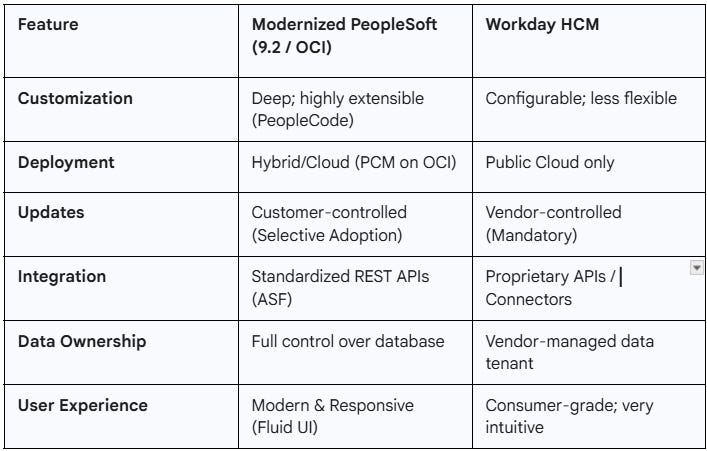
Feature Matrix: Modernized PeopleSoft vs. Workday
The Five-Month Arbitrage
Let’s look at a concrete scenario. A global manufacturer with 30,000 employees needs to modernize. They want mobile self-service, real-time dashboards, and automated performance reviews.
They have two choices.
Path A: They spend three years and tens of millions of dollars migrating to a SaaS platform. During those three years, innovation stops. The business is in a defensive crouch, focused entirely on the migration.
Path B: They choose a modular upgrade to PeopleSoft 9.2. They layer Fluid UI over their existing payroll engine. They move the infrastructure to Oracle Cloud Infrastructure (OCI) to automate patching.
In a real-world case, an organization chose Path B and went live in five months. They didn’t just “stay current”; they achieved a 50% improvement in processing speed and a 25% increase in user productivity.
That isn’t a compromise. That is an arbitrage. They gained the benefits of the cloud without the “migration tax.”
The Cost of Discomfort
I want to be honest about the tradeoffs. Choosing the modular path requires a specific kind of discipline. It requires you to be intentional about “de-customization.” It requires you to adopt tools like the PeopleSoft Test Framework to automate regression testing, as Ubisoft did to accelerate their testing cycles by 70%.
The discomfort here isn’t technical; it’s cultural. It requires IT and the business to talk to each other more frequently. You can’t just “set and forget” the system. You have to actively manage the roadmap.
But the alternative is the “update treadmill” of SaaS, where you lose the ability to say “no” to a change that might break your most critical business process.
The Strategic Fork
We are entering an era of “intelligent evolution.”
The choice before you is not “Cloud vs. On-Premises.” That is an outdated distinction. Most modernized PeopleSoft systems are already running in the cloud.
The real choice is between a rigid system and a modular one.
A full replacement is an all-or-nothing bet on a vendor’s vision of how your business should run. A modular modernization is a bet on your own history, enhanced by modern technology. One path values the “clean slate” above all else. The other values institutional knowledge.
In the enterprise, knowledge is the only thing that is truly hard to replace.
The “rip and replace” era is ending not because the technology failed, but because the strategy was too expensive and too risky. Modularity is the only source of long-term competitive advantage.
The most innovative move you can make today might just be to stay exactly where you are—and change everything about how you run it.
The composable ERP model enabled by ASF and API Gateways ensures that PeopleSoft can serve as the robust core of a modern, multi-cloud ecosystem. Organizations are no longer locked into a single vendor’s roadmap but are free to integrate the best-of-breed tools that match their unique strategic needs.
I’ll leave you with this. For many enterprises, the most innovative move is not to replace their most critical system, but to modernize it. By embracing a modular architecture, PeopleSoft customers can enjoy the best of both worlds: the stability and depth of a mature ERP, and the speed, scalability, and user-centricity of the cloud. The “rip and replace” era is giving way to an era of “intelligent evolution,” where modularity is the ultimate source of competitive advantage.